
Accuracy
Are all the values correct? For example, is the name spelled correctly? Is the dollar amount recorded properly?
Completeness
Are any of the values missing? For example, is the address complete including street, city, state and postcode?
Consistency
Is aggregate or summary information in agreement in detailed information? For example, do all total fields equal the true total of the individual fields?
Uniqueness
Is each transaction, entity and event represented only once in the information? For example, are there any duplicate customers?
Timeliness
Is the information current with respect to the business requirements? For example, is information updated weekly, daily, or hourly?
2. Define the relationship between a database and a database management system.
A database maintains information about various types of objects. In business, organisational information is stored in a database.
Applications and programs, such as supply chain management systems and customer relationship management systems, access the data in the databases the program can consult it to answer queries. The records retrieved in answer to questions become information that can be used to make decisions. The computer program used to manage and query a database is known as a database management system (DBMS). The properties and design of database systems are included in the study of information science.
An Introduction to Relational Databases
3. Describe the advantages an organisation can gain by using a database.
The advantages an organisation can gain from using a database include:
- Increased flexibility - database tend to mirror business structures and a good database can handle changes quickly and easily. It also provides flexibility i allowing each user to access the information in whatever way best suits the company's requirement.
- Increase scalability and performance - Only a database could 'scale' to handle the massive volumes of information and the large numbers of users required for the successful business. Scalability refers to how well a system can adapt to increased demands. Performance measures how quickly a system performs a certain process or transaction.
- Reduced information redundancy - Eliminating the duplication of information an organisation helps to save space, makes performing information updates easier and improves information quality.
- Increased information integrity (quality) - The specification and enforcement of integrity constraints produce higher quality information that will provide better support for business decision. It helps to reduce the information error rates and increase the use of organisational information.
- Increased information security - As systems become increasingly complex and more available over the internet, security has become an even bigger issue. Databases offer many security features including passwords, access levels, and access controls. Various security features of databases can ensure that individuals have only certain types of access to certain types of information.

4. Define the fundamental concepts of the relational database model.
The primary concepts of the relational database model are entities, entity classes, attributes, keys and relationships.
- an entity - in the relational database model is a person, place, thing, transaction or even about which information is stored.
- an entity class - is the collection of similar entities.
- attributes - also called fields or columns, are characteristics or properties of an entity class.
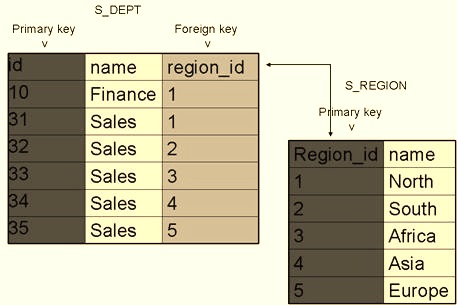
- keys - include a primary and a foreign key, primary key is field (or groups of field) that uniquely identifies a given entity in a table. A foreign key is a primary key of one table that appears as an attribute in another table and acts to provide a logical relationship between two tables.
5. Describe the benefits of a data-driven website.
There are many advantages which are list and explained below:
Development
Allows the website owner to make changes any time without having to rely on a developer or knowing HTML programming. A well-structured, data-driven website enables updating with little or no training.Content management
A static website requires a programmer to make updates. This adds an unnecessary layer between the business and its web content, which can lead to misunderstandings and slow turnarounds for desired changes.
Future expandability
Having a data-driven website enables the site to grow faster than would be possible with a static site. Changing the layout , displays and functionality of the site (adding more features and sections) is easier with a data-driven solution.
Minimising human error
Even the most competent programmer charged with the task of maintaining many pages will overlook things and make mistakes. This will lead to bugs and inconsistencies that can be time consuming and expensive to track down and fix. A well-designed, data-driven website will have 'error-trapping' mechanisms to ensure that required information is filled out correctly and that content is entered and displayed in its correct format.
 Cutting production and update costs
A data-driven website can be updated and ' published' by any competent data-entry or administrative person. In addition to being convenient and more affordable, changes and updates will take a fraction of the time that they would with a static site.
More efficient
With a data-driven solution, the system keepers track of the templates, so users do not have to. Global changes to layout, navigation or site structure would need to be programmed only once, in one place, and the site itself will take care of propagating those changes to the appropriate pages and areas. A data-driven infrastructure will improve the reliability and stability of a website, while greatly reducing the chance of ' breaking' some part of the site when adding new areas.
Improved stability
Any programmer who has to update a website from 'static' templates must be very organised to keep track of all the source files. If a programmer leaves unexpectedly, it could involve recreating existing work if those source files cannot be found. Plus, if there were any changes to the templates, the new programmer must be careful to use only the latest version. With a data-driven website, there is peace of mind, knowing the content is never lost-even if your programmer is.
6. Describe the roles and purposes of data warehouses and data marts in an organisation
Data warehouse – a logical collection of information, gathered from many different operational databases, that supports business analysis activities and decision-making tasks.
The primary purpose of a data warehouse is to aggregate information throughout an organisation into a single repository for decision-making purposes
A data mart - contains a subset of data warehouse information.
To distinguish between data warehouses and data marts, think of data warehouses as having a more organisational focus and data marts having focused information subsets particular to the needs of a given business unit such as finance or production and operations.

Textbook: Baltzan, Phillips, Lynch & Blakey, Business Driven Information Systems, 1st Australian/New Zealand ed, chapter 6

Textbook: Baltzan, Phillips, Lynch & Blakey, Business Driven Information Systems, 1st Australian/New Zealand ed, chapter 6

No comments:
Post a Comment