Chapter 3 Questions
1. Why has the web grown so dramatically?

The web started to be used more by businesses since 1990s. It only took 10 years for it to become a common place for people in most countries in the world. Today, business could not be able to survive without a web address. There are two major reasons for the web to grow so quickly in the past decade.
Firstly, with the improved telecommunication infrastructure, the access to internet has become relatively easy. Particularly in recent years, with the popularity of wireless as well as the internet application built in the smartphones, iPhone for instance.
Secondly, along with globalization, the web has contributed to the success of many cooperations and entities around the world. Many international entities have enjoyed the benefit of the web and become dominant in their area of business. Companies like eBay, Amazon, and Dell relied purely on the web users to purchase their products online.

The web started to be used more by businesses since 1990s. It only took 10 years for it to become a common place for people in most countries in the world. Today, business could not be able to survive without a web address. There are two major reasons for the web to grow so quickly in the past decade.
Firstly, with the improved telecommunication infrastructure, the access to internet has become relatively easy. Particularly in recent years, with the popularity of wireless as well as the internet application built in the smartphones, iPhone for instance.
Secondly, along with globalization, the web has contributed to the success of many cooperations and entities around the world. Many international entities have enjoyed the benefit of the web and become dominant in their area of business. Companies like eBay, Amazon, and Dell relied purely on the web users to purchase their products online.
2. What is Web 2.0, how does it differ from 1.0?
Web 2.0 is a set of economic, social and technology trends that collectively form the basis for the next generation of the internet. It is not an update of technical specifications, but more focused on changes of how software developers and end-users use the web as a platform.
Web 2.0 propels companies in all industries to adopt a new way to do business. Those businesses that has acted on the web 2.0 opportunity got the advantage early in their markets. Facebook and Twitter are the best examples of it.
Comparing web 2.0 to 1.0, web 2.0 provides more interacting surface for users while there was not much room allowing interaction in web 1.0 which it mainly provided users the functions of publishing and page views.
Web 2.0 is a set of economic, social and technology trends that collectively form the basis for the next generation of the internet. It is not an update of technical specifications, but more focused on changes of how software developers and end-users use the web as a platform.
Web 2.0 propels companies in all industries to adopt a new way to do business. Those businesses that has acted on the web 2.0 opportunity got the advantage early in their markets. Facebook and Twitter are the best examples of it.
Comparing web 2.0 to 1.0, web 2.0 provides more interacting surface for users while there was not much room allowing interaction in web 1.0 which it mainly provided users the functions of publishing and page views.
3. How could a web 2.0 technology be used in business?
Web 2.0 technology has brought the business competition to a new level. For those businesses that master this technology at their advantage, the could easily grab more market shares in their industry. The key element is interaction.
The way how potential customers can write an email and inquire about products or services they are interested in is getting out-of-date now. There are many new efficient ways of utilizing the web.
A very good example is with telecom company, Optus. They operate a very competitive strategy by providing online customer service officers on their website. These customer service officers take the active step by asking if you need any help with their products even you are just happened to be browsing the site. It opens a conversation window and you do not have to answer them if you don't want to but it gives instance answers to potential customers just as if you were in their stores. In fact, it might be better than stores as customers seem to have to wait for service a lot of times.
This online personal shopping experience is efficient and smart. It will be the new best way for web 2.0 businesses marketing.
4. What is eBusiness, how does it differ from eCommerce?
 eBusiness is the conducting of business of the internet including buying selling, servicing customers and collaborating with business partners.
eCommerce is purely the acts of buying and selling of good and services over the internet.
The main difference between eBuiness and eCommerce is that the eBusiness also refers to online exchange of information. It allows suppliers for a manufacturer to monitor the production schedules or the customers to review banking, credit card and mortgage accounts in a financial institution.

eCommerce is purely the acts of buying and selling of good and services over the internet.
The main difference between eBuiness and eCommerce is that the eBusiness also refers to online exchange of information. It allows suppliers for a manufacturer to monitor the production schedules or the customers to review banking, credit card and mortgage accounts in a financial institution.
5. What is pure and partial eCommerce
Pure eCommerce refers to businesses trade purely online, and there are no physical shops existed. Examples are: iTune, Dell, Amazon and eBay.
Partial eCommerce are those Businesses that have physical shops for customers to walk in and purchase good or services in store as well as on their websites. This practice has been adopted by most successful businesses to cater the demands of the public. Businesses lead this by examples are Coles, Woolworth, Telstra, Topshop...etc.

6. List and describe the various eBusiness models?
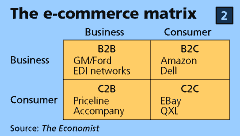
Applies to businesses buying from and selling to each other over the internet.
Business-to-Consumer (B2C)
Applies to any business that sells its products or services to consumers over the internet.
Consumer-to-business (C2B)
Applies to any consumer that sells a product or services to a business over the internet.
Consumer-to-consumer (C2C)
Applies to sites primarily offering goods and services to assist consumers interacting with each other over the internet.
7. List and describe the major B2B models?
ference between eBu B2B (Business-to-business) applies to businesses buying from and selling to each other over the internet. Electronic marketplaces represent a new wave in B2B eBusiness models.
They are interactive business communities providing a central market where many buyers and sellers can bid against each other. They provide structures for conducting commercial exchange, consolidating supply chains and creating new sales channels. Transactions are usually conducted via intranet. (Often using a virtual private network or VPN)
8. Outline 2 opportunities and 2 challenges faced by companies doing business online?
Opportunities:
a. Sales not restricted to facts like geography or population, even religions or cultures as goods and services can be sold over the world via internet.b. Fixed and variable costs for labor and renting a physical shop drop dramatically with doing business online.
Challenges:
c. Business online today face huge competition around the world as there are many more people doing it, customers have more options to compare and choose the products with indicated prices.
d. Laws and regulations in different countries can be tricky for online eBusiness owners. It is often complicated and difficult to understand them in order to trade in the countries that eBusiness owners not familiar with.

Textbook: Baltzan, Phillips, Lynch & Blakey, Business Driven Information Systems, 1st Australian/New Zealand ed, chapter 3

No comments:
Post a Comment